Laura and I did not meet over flowers. We met over soil. She was talking about cover crops and compost and what a field owes you back after a hard season; I was talking about lime and hemp and wool and where a material goes when a house is done with it. It turned out to be the same conversation held at two different scales. Tekla Farms is the place where those two halves finally met, and the collaboration grew straight out of it.
The division of labor is simple and it has never once needed renegotiating. Laura grows the flowers. I design with them. She plans the rows a year out, feeds the ground rather than the plant, keeps pesticides off the field entirely, and raises blooms that were bred for scent and character instead of for surviving a shipping container. I turn up in the week the field is generous and cut accordingly.
You cannot design a season. You can only turn up in the week the field is generous, and cut accordingly.
Whitney Page
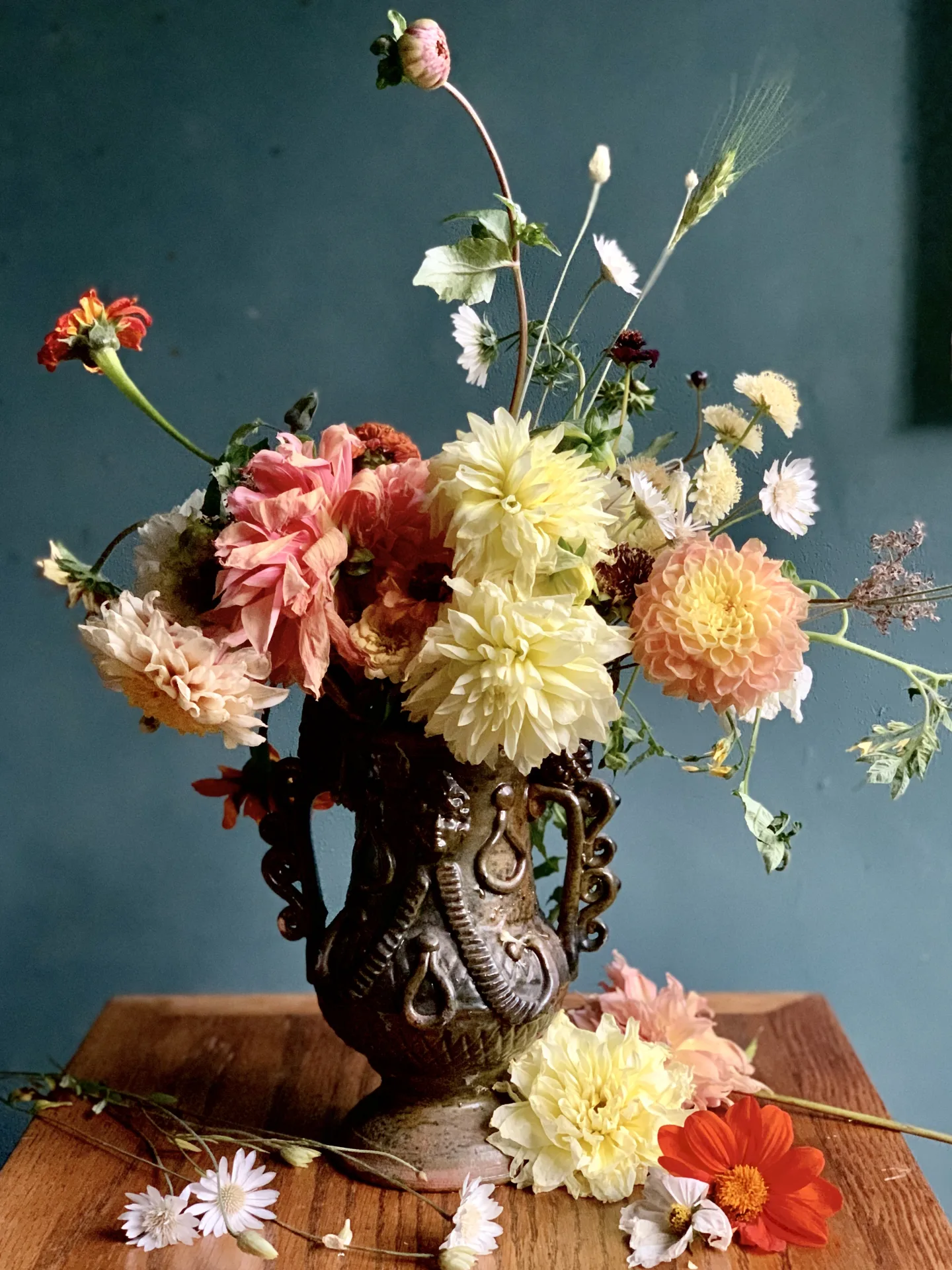
What that gives me as a designer is material nobody can buy wholesale. Stems with a bend in them. Dahlias too blown open to survive a truck. Seed heads, grasses, branches, a poppy that will be finished by Thursday and is worth the whole arrangement on Tuesday. The arrangements are built the way a Dutch still life is built—deep color, honest asymmetry, a structure of foliage set first so the flowers have something to lean on—and they are only possible because the field is a hundred yards from the bench.
Soil first, always
Both of us came to this through agriculture rather than through floristry, and it shows in the order we do things. Healthy soil grows a stronger stem; a stronger stem holds a week in the vase; a flower that holds a week does not need a chemical dip or a block of floral foam to prop it up. Nothing about this is a look. It is just what happens when the ground is treated as the asset it is.
Continued: the seasonal classes